Your shift. One conversation.
Resident prepares the work. The radiologist decides and signs.
A support tool for professionals. Not a medical device. Clinical AI features run in research mode.
A shift in six scenes
01 / 06
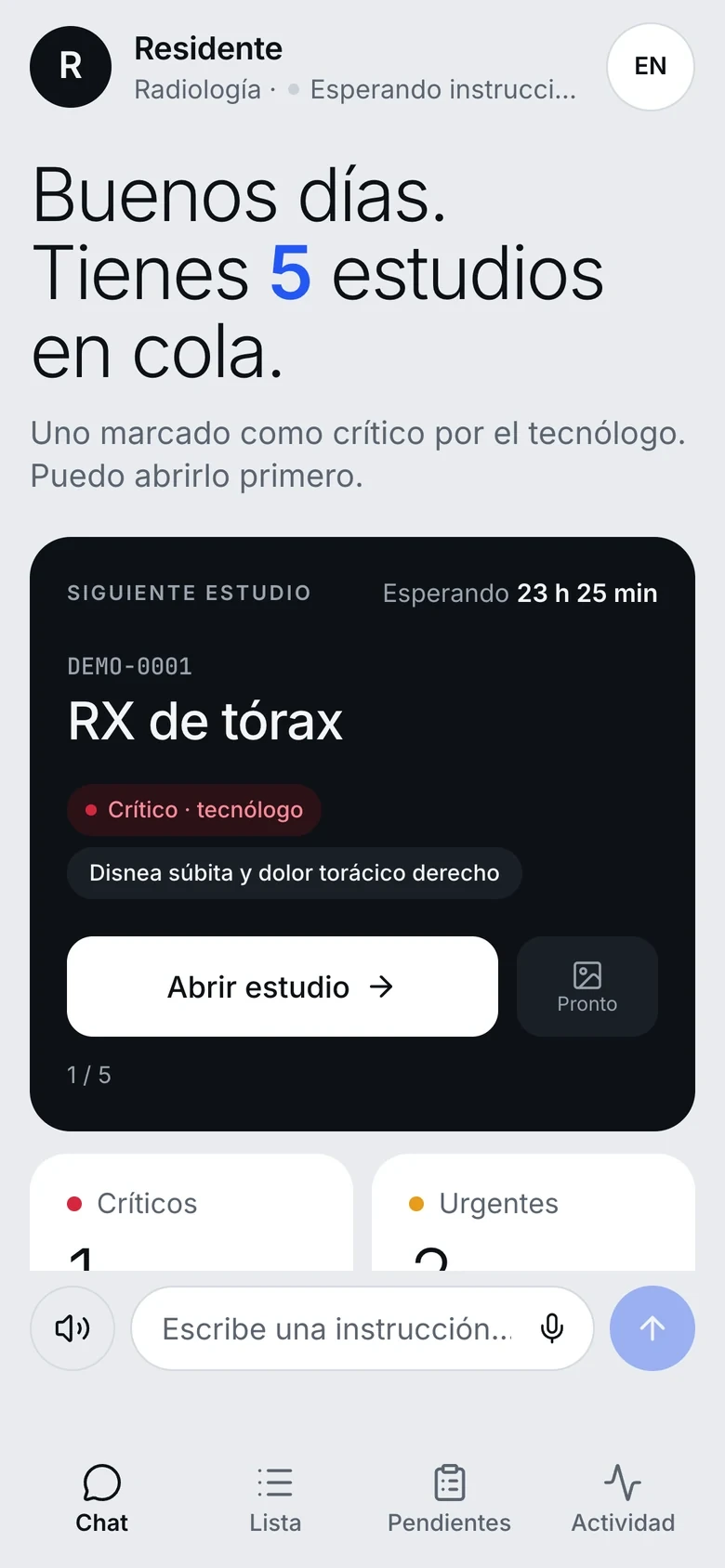
Know where to begin.
The start screen shows the next study, how long it has been waiting and the queue status, so the shift begins with a concrete action.
Priority should have a visible reason, not an unexplained AI score.
Implemented · app screenshot
What the clinician reads is the conclusion.
A finding that never reaches the conclusion. A clinical question left unanswered. RadMesh looks for them before signing; the radiologist decides.
Four agents. One shift.
Every task in the shift has an agent. Each one logs what it did. None of them signs, and none lowers a priority set by a human.
Press 1–4
The worklist is ordered by turnaround target and by the technologist's flag, with the reason visible on every row.
| Study | Waiting | Reason |
|---|---|---|
| DEMO-0001Chest X-ray | 5 h 12 min | Flagged by the technologist |
| DEMO-0004Chest CT | 4 h 20 min | Due in 40 min |
| DEMO-0003Chest X-ray | 3 h 05 min | Order: urgent |
| DEMO-0002Abdominal CT | 1 h 40 min | Order of arrival |
| DEMO-0005Chest X-ray | 0 h 25 min | Order of arrival |
For the radiologist
- AI Mode by chat or by voice, in Spanish or in English.
- Guided reading: "1 of 15"; you move forward, nothing happens on its own.
- Draft on your own template (research mode).
- Dictation with your template and the procedure code of the order.
- Sign in two taps; voice never signs.
- Reading mode without distractions.
- If the AI does not respond, you keep working.
Turnaround under control, with a RIS that is yours.
- No PACS change: it connects over DICOM from a VM in your network.
- Worklist with the reason in view: by turnaround target and by the priority of the order and the technologist.
- Reading targets and backup: it warns before a target is missed and suggests who can read.
- Connected shifts: it knows who is on shift from Clicrad.
- WhatsApp and Slack notices: only to staff on shift, with no patient data.
- Service quality: what gets corrected before signing, for training.
- Service templates: personal and shared, without junk templates.
The studies stay in Colombia.
Your studies live on a node dedicated to your institution, on servers in Colombia: we host it or, if your hospital prefers, it runs on its own servers.
- The RadMesh central service only handles licenses, updates and signed models. It does not store patient data.
- Each node is independent: one institution's data never mixes with another's or passes through the central service.
- Access with a personal user and mandatory second factor.
- Notices never include patient data.
- Your studies are not used to train models without a signed agreement with your institution.
- Any research use is approved by your own ethics committee.
How we start
Live demo.
A 30-minute video call with synthetic cases: the whole shift, from the worklist to the signature.
Connection.
Your IT team adds a DICOM destination. Nothing else changes in your PACS. We host and operate the node.
# DICOM destination in your PACSAE TitleRADMESHHostpuente-dicom (VM in your network)Port11112Pilot with your team.
We set up templates, shifts and reading targets, train the radiologists and stay with them during the pilot.
What RadMesh is, and what it is not.
- It is not a medical device; the radiologist decides and signs.
- Clinical AI runs in research mode.
- Internal evaluations with synthetic cases, not clinical validation.
Want to see how we measure the review before signing? Ask for the technical report.
Frequently asked questions
Do we have to change the PACS or the equipment?
No. RadMesh receives the studies over DICOM from your current PACS.
Does the AI replace the radiologist?
No. It prepares a draft and reviews the wording before signing. The radiologist decides, corrects and signs; nothing signs itself.
Where are the studies kept?
Your studies live on a node dedicated to your institution, on servers in Colombia: we host it or, if your hospital prefers, it runs on its own servers.
What happens if the AI fails or does not respond?
The RIS keeps working. RadMesh shows that the review is unavailable and the radiologist reads and signs as always.
Does it work in Spanish?
Yes. Chat, voice, draft and templates are in Spanish; it also works in English.
Who is responsible for the report?
The radiologist who signs it, as always. RadMesh is the tool; the clinical decision belongs to the professional.
How is it contracted?
After the demo we talk with you about how RadMesh fits your service.
See a full shift in 30 minutes.
From the worklist to the signature, with synthetic cases and your own team on the call.
Explore with your AI
An external service will open with this question and a link to our public overview. No clinical data or private code is attached. That service generates the answer; check its claims against the source.
View and copy the question
Read this presentation of RadMesh AI Mode (https://www.radicalmesh.com/about/ai-mode-en.txt) and explain how it could help a small or mid-sized radiology service in Colombia, and which questions I should ask in the demo.